In the French doors vs sliding doors debate, the short answer is this: choose French doors if you want a classic look, a full-width opening and the tightest seal of the two, and choose a sliding patio door if floor space is tight and you want the largest uninterrupted glass for the money. If your opening is wide and your budget allows, a European lift-and-slide door often beats both, combining slider convenience with sealing that comes much closer to a hinged door.
Below we compare the two on the factors that actually matter in a Toronto home: space, opening width, view, winter performance, security, style, accessibility and cost. The verdict at the end is organized by scenario, because the right patio door depends on the room, the house and how you live.
How French Doors and Sliding Patio Doors Work
French doors are a pair of hinged, glazed door leaves that swing open, either inward or outward, and typically meet in the middle with no fixed post between them. When both leaves are open, the full width of the frame is clear.
Sliding patio doors have one or more glass panels that glide horizontally along a track. A standard two-panel slider has one fixed panel and one operating panel, so it opens roughly half its width. Larger configurations with three or four panels, or panels that slide into a wall pocket, can open much wider.
There is also a third category worth knowing about before you decide: lift-and-slide. It is a heavier-duty sliding system where turning the handle lifts the panel onto rollers to move it, then lowers it back onto its seals when closed. We cover it in detail further down.
Space and Swing Clearance
This is where sliding doors win outright. A slider needs no clearance at all beyond its own frame, so you can place a sofa, a dining table or a planter right up against it. That makes sliders the practical choice for compact kitchens, narrow family rooms and condo terraces.
French doors need a clear arc equal to the width of each leaf. With inswing doors, that space has to stay free inside the room. With outswing doors, it has to stay free on the deck or patio. In Toronto, outswing doors bring an extra consideration: snow and ice on a deck can block them from opening in winter unless the area is kept clear or covered. Inswing doors avoid that problem but cost you interior floor space.
Opening Width and Airflow
French doors open 100 percent of their frame width when both leaves are swung open, which is ideal for moving furniture, hosting, or simply letting the room breathe on a summer evening. A standard two-panel slider, by contrast, only ever opens about half its width.
If the full-opening experience is what draws you to French doors but space is the problem, look at multi-panel sliders, pocket sliders and folding systems. Our bi-fold doors stack panels to one or both sides and can clear almost the entire opening, though the stacked panels take up some room and there are more vertical frames to look through when closed.
Glass Area and View
Sliders generally deliver more glass and fewer interruptions. Each panel is a single large pane with a relatively narrow interlock where the panels meet. French doors have a frame around each leaf plus the meeting stiles in the middle, so the total frame width across the opening is greater. Many traditional French doors also use simulated divided lites, which add character but further break up the view.
At the premium end, the difference grows. European aluminum sliding systems such as the Reynaers MasterPatio are designed around large panels and slim profiles, which is why they are a common choice when a view of a ravine, garden or lake is the main event.
Airtightness and Winter Performance
For a cold-climate city like Toronto, this is the factor homeowners most often underestimate. A hinged French door closes against compression gaskets and, on quality units, locks at multiple points along its height, pulling the leaf tight against the frame. That generally makes French doors better at keeping out drafts than standard sliders.
A conventional slider has to move, so it relies on brush or pile weatherstripping that the panel slides past. That design is inherently leakier, and the weatherstripping wears with use. On a cheap slider, you can often feel cold air at the interlock in January.
Lift-and-slide systems solve this problem. When the handle is turned to lock, the panel drops down onto its gaskets, compressing them in a way a standard slider cannot. The result is sealing that comes much closer to a hinged door. Whatever style you choose, check the specific product's rated performance and, where relevant, its listing with ENERGY STAR Canada. Glazing matters too: triple glazing and warm-edge spacers are worth considering on any large patio door in our climate.
Security
Older and budget sliders earned a poor reputation for security because some operating panels could be lifted off their track. Modern quality sliders address this with anti-lift blocks and multi-point locks, so the gap has narrowed considerably.
French doors with multi-point locking hardware engage the frame at the top, bottom and middle, which is very secure. The weak point on any double door is the inactive leaf, so make sure its top and bottom bolts are robust. Lift-and-slide doors are also strong performers: once lowered and locked, the panel sits down on its track and is difficult to force upward. For any ground-floor patio door, consider laminated glass for an extra layer of protection.
Style: Traditional vs. Modern
French doors are the natural fit for Georgian, Tudor, Colonial and many transitional homes in neighbourhoods across Toronto and the GTA. Painted or stained wood interiors, divided lites and traditional hardware all reinforce that character.
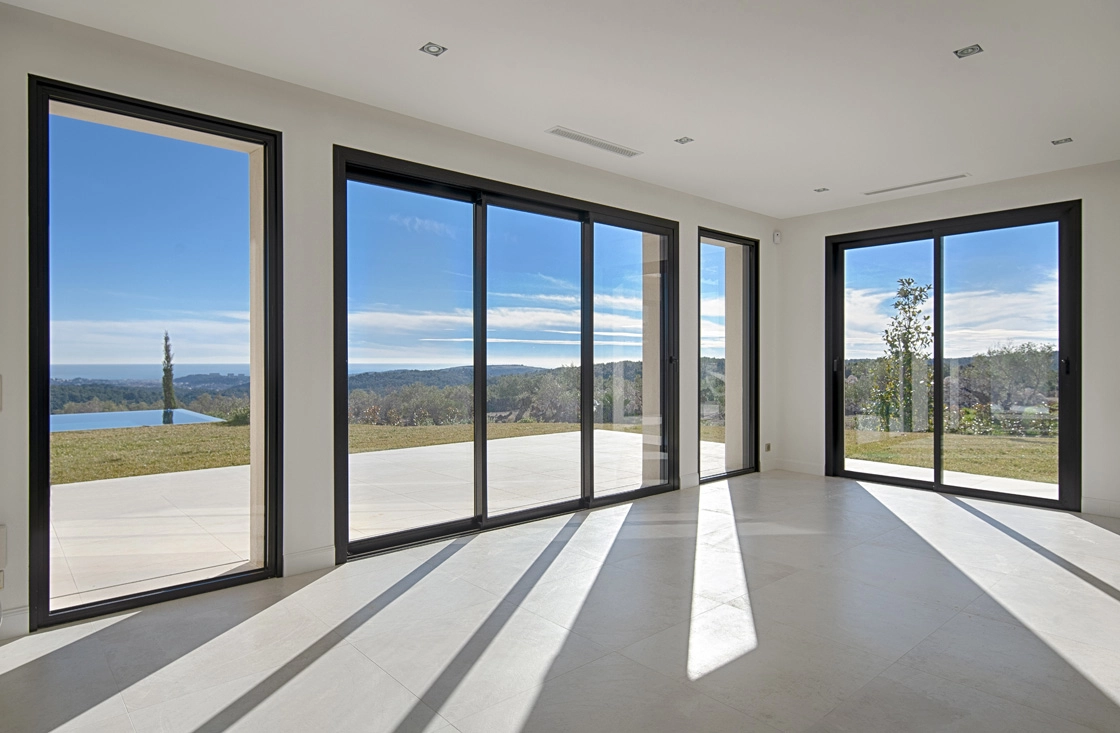
Large sliders and lift-and-slide systems suit modern and contemporary architecture: flat roofs, open-plan interiors and floor-to-ceiling glass. Slim aluminum frames in black or bronze finishes read as clean and architectural.
If you love the look of French doors but cannot spare the swing space, there is a hybrid. The Weather Shield French sliding patio door uses wide, panelled frames that resemble a hinged French door but operates as a slider. Explore the full range of Weather Shield wood-clad doors, including the standard Weather Shield sliding patio door, if warm wood interiors suit your home.
Accessibility and Thresholds
French doors usually have a raised sill that the leaves close against to form a weather seal. Standard sliders also have a raised track. Both can be a trip hazard and an obstacle for wheelchairs, walkers and strollers.
Many European lift-and-slide systems offer low or recessed threshold options that bring the floor almost level from inside to out, which is a large part of their appeal for indoor-outdoor living and aging-in-place planning. A flush threshold must be detailed carefully with drainage and the exterior grade, so this is a decision to make with your installer early in a build or renovation, not after the floor is finished.
Cost and Lead Time
For a typical opening, a standard sliding patio door is usually the most affordable of the three. Quality French doors cost more because of the extra leaf, hinges and multi-point hardware. Lift-and-slide systems sit at the top, reflecting heavier hardware, larger glass and more complex installation.
European systems also take time: manufacturing lead times are typically 8 to 14 weeks, so build that into your schedule. For brand-by-brand pricing, see our guide to luxury European door costs in Toronto. And to be candid: if you are replacing a builder-grade slider on a standard opening and the house does not call for a statement door, a well-made North American slider can be the right call.
The Premium Third Option: European Lift-and-Slide
When homeowners asking about lift and slide vs French doors visit our North York showroom, the deciding factor is usually opening size. Lift-and-slide hardware carries very large, heavy glass panels on rollers, so even oversized panels glide with light effort. Add the compressed-gasket sealing and low threshold options, and you get the openness of a slider with weather performance much closer to a hinged door.
The trade-offs are cost, weight and the need for proper structural support and installation. Our lift and slide doors guide covers configurations in depth, or browse our lift and slide doors in Toronto and, for York Region projects, lift and slide doors in Vaughan.
| Factor | French Doors | Standard Slider | Lift-and-Slide |
|---|---|---|---|
| Swing clearance needed | Yes, one leaf width | None | None |
| Opening width | Full frame width | About half | Half to full, depending on configuration |
| Glass area and view | Good, more framing | Very good | Excellent, large panels |
| Airtightness | Very good (compression seals) | Fair (brush seals) | Very good (panel lowers onto gaskets) |
| Security | High with multi-point locks | Good on modern units | High |
| Style | Traditional, transitional | Versatile | Modern, contemporary |
| Threshold | Raised sill | Raised track | Low or recessed options |
| Relative cost | Mid | Lowest | Highest |
Our Verdict by Scenario
- Traditional home, room to spare: French doors. They suit the architecture, seal well and open the full width.
- Tight kitchen or family room: a quality slider, or a French-style slider if you want traditional character.
- Modern home with a wide opening and a view: lift-and-slide. It is the strongest all-round performer for large openings.
- Maximum indoor-outdoor connection: lift-and-slide with pocketing panels, or bi-fold if you want the entire wall to open.
- Budget-conscious replacement of a standard opening: a well-made conventional slider is often the sensible choice.
See Them Side by Side
The best way to settle the French doors vs sliding doors question is to operate them yourself. Our showroom at 126 Tycos Dr in North York displays systems from seven European and North American brands, and our team can walk you through custom patio doors sized for your opening. Book a showroom visit or request a consultation and we will help you match the right door to your home, climate and budget.